
We talk a lot about stakeholder management.
I have never particularly liked the word “management” in this context. People aren't there to be managed. What we are really trying to do is understand people, build relationships, navigate different interests and, ultimately, influence outcomes.
And the more senior you become, the more important this gets.
You rarely achieve anything significant entirely on your own. There are people whose support you need, people who can slow things down, people who can open doors, people who have information you don't have, and people who may influence the decision-maker far more than their title suggests.
But there is another reality we don't talk about enough:
You cannot invest equally in every stakeholder.
Your time is finite. Your attention is finite. And your influence capital is finite.
So perhaps a better question than “How do I manage my stakeholders?” is:
Where should I invest my influence?
Start with two questions
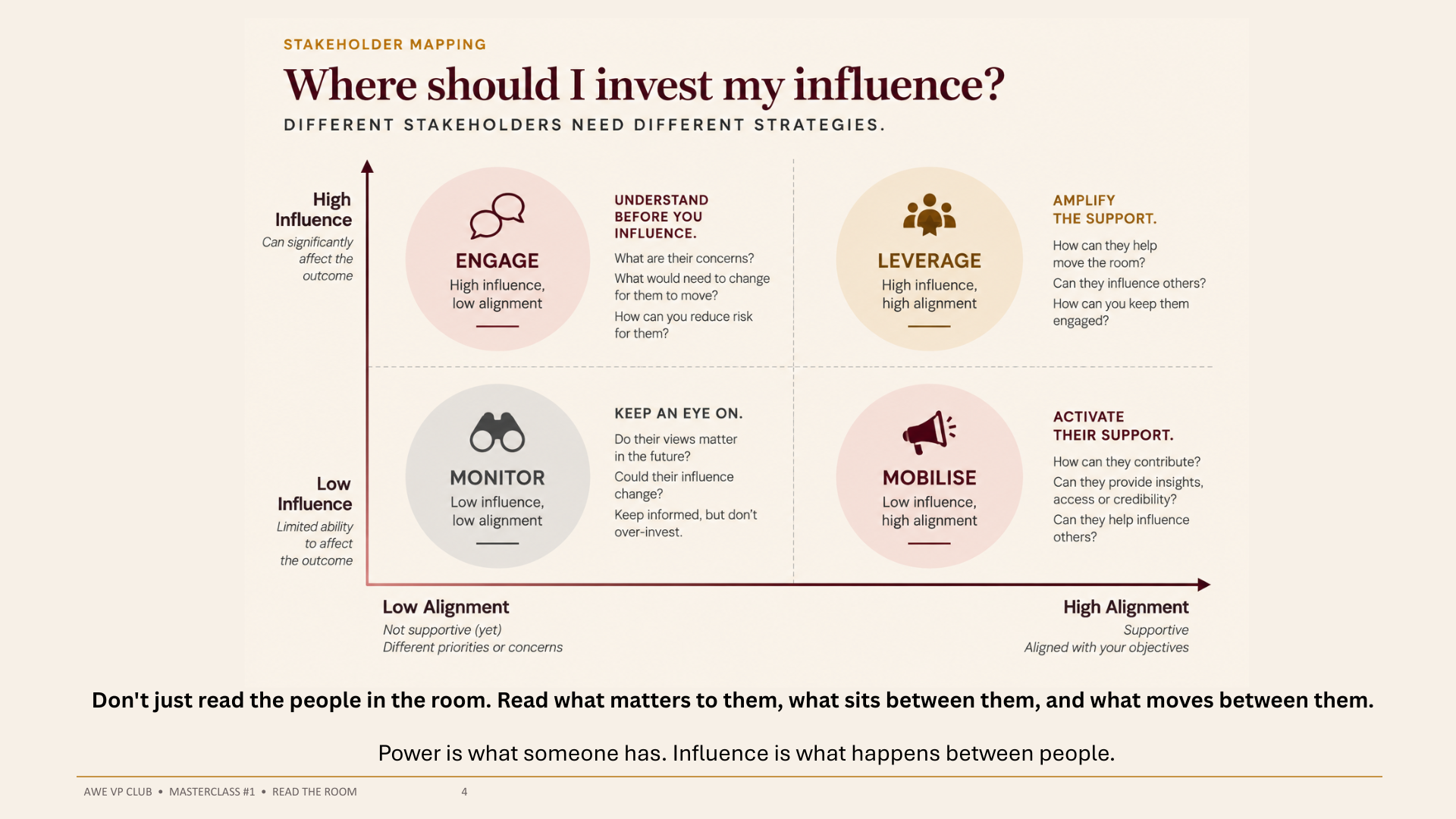
For any important initiative, decision or career objective, map the people around it against two dimensions.
How much influence do they have?
Not simply: how senior are they?
Ask instead: How much can this person actually affect the outcome? Can they approve it, stop it, delay it, shape it, influence someone else, or determine whether it gets implemented successfully?
Then ask:
How aligned are they with what I am trying to achieve?
Are they supportive? Do they see things differently? Are they unconvinced? Do they have competing priorities or concerns?
Put those two dimensions together and you get four very different stakeholder situations — requiring four very different investments of your time.
1. Engage — High Influence × Low Alignment
This is probably where your greatest investment of influence belongs.
When someone has considerable influence but is not aligned with you, our instinct can be to work harder at convincing them.
I would start somewhere else.
Understand before you try to move.
Why aren't they aligned?
Perhaps they see a risk you haven't considered. Perhaps their priorities are different. Perhaps the timing is wrong. Perhaps they are protecting resources, reputation or another commitment. Perhaps they don't trust the data.
Or perhaps they don't trust you yet.
Sometimes what looks like resistance is simply information we haven't bothered to uncover.
So before preparing another argument, ask:
What am I missing about why this person sees the situation differently?
A high-influence, low-alignment stakeholder doesn't necessarily need a better pitch. They may need a better conversation.
2. Leverage — High Influence × High Alignment
This is an interesting group because we can easily take them for granted.
“They're supportive. Great. Next stakeholder.”
But if someone is both supportive and influential, their value may go well beyond giving you their vote.
Ask:
- Who else listens to them?
- Could they challenge your thinking before you enter the room?
- Could they help you understand another stakeholder?
- Could they open a conversation you cannot easily access?
- Could they become a credible voice for the idea when you are not there?
And perhaps the most uncomfortable question:
Would they sometimes be a better messenger than you?
Influence isn't always about being the person doing the influencing. Sometimes it is knowing when somebody else can move the room more effectively than you can.
3. Mobilise — Lower Influence × High Alignment
“Lower influence” does not mean unimportant.
Someone may not have the authority to make the final decision but may have valuable information, relationships, credibility or implementation knowledge.
They may also collectively create momentum.
So don't dismiss people simply because they don't sit high enough on the organisation chart.
Ask: How can I activate their support?
- Perhaps they can provide insight.
- Perhaps they can help you understand what is happening on the ground.
- Perhaps they know someone you need to reach.
- Perhaps they can help others see the idea differently.
And if you discover that this person actually has substantial informal influence over others, reconsider where you placed them on the grid.
Influence and hierarchy are not the same thing.
4. Monitor — Lower Influence × Low Alignment
This is perhaps the hardest quadrant for ambitious leaders because we often want to win everyone over.
We don't need to.
Some stakeholders currently have limited ability to affect the outcome and are not particularly aligned with what we are trying to achieve.
That doesn't mean ignore them. It means don't over-invest.
Keep them informed where appropriate. Watch whether their concerns, position or influence changes. But don't spend disproportionate energy trying to convert every person who disagrees with you.
That time may be much better spent understanding the high-influence stakeholder whose support really matters.
There is discipline in knowing where not to spend your influence.
The map is not the answer
This is important. I wouldn't use this grid to permanently label people.
Stakeholders move.
An ally today may disagree with your next proposal. Someone with little influence today may become critical during implementation. A resistant stakeholder may become one of your strongest supporters once you understand what is behind the resistance.
So the purpose of the map isn't to put people into boxes. It is to make us think more strategically about our relationships.
And once you have mapped them, the more interesting questions begin:
- What matters to this person?
- What do I know about their position — and what am I merely assuming?
- What might they be protecting?
- Who influences them?
- What would they be risking by supporting me?
- What relationship have I built with them before I need something?
Those questions take us from stakeholder mapping to stakeholder influence.
Sometimes the work happens before you enter the room
One of the most useful disciplines in stakeholder influence is pre-wiring.
An important meeting should rarely be the first time a critical stakeholder encounters your idea.
That doesn't mean secretly engineering agreement before everyone gets into the room. It means doing the work beforehand.
- Listen.
- Test assumptions.
- Surface objections.
- Understand competing priorities.
- Find out what you haven't considered.
- Adapt the proposal where the feedback improves it.
- And know where genuine disagreement still exists.
The objective isn't to walk into the room knowing everyone will agree with you. It is to walk in knowing there should be few avoidable surprises.
Influence is an investment
The higher we rise, the less leadership is simply about the quality of our own work.
It increasingly becomes about our ability to understand the environment around us, build credibility and trust, navigate different priorities, bring people with us and know when someone else should take the lead.
So perhaps before your next important initiative, don't start with:
“How am I going to convince them?”
Start with:
Who really matters here — and where should I invest my influence?